I was an intern, hear me roar

“If you’re good at something, never do it for free.”

Words of wisdom, if from an odd source (Heath Ledger’s Joker in “The Dark Knight”).

As we get further into June, so begins that magical summertime stretch of Internship Season. Each year, thousands of high school and college students get experience in their industries of choice. Some get paid, some don’t.

Recently, there’s been a big to do about unpaid internships and the ethics involved in them. Seeing many of my friends go off to their own summer gigs, it got me reminiscing and thinking about my intern days.

I have been extraordinarily fortunate in my summer work. I didn’t have the time to intern the summers before and after I studied abroad, but the summer after my junior year, I earned a Dow Jones editing internship at the Indianapolis Star. A Dow is pretty much the gold standard in editing internships, and I had a great summer in Indy.

My next two internships — in the summer of 2009 after I graduated from KU and in the summer of 2010 before I came to Canterbury — were also with large, respected newspapers: the Columbus Dispatch and Kansas City Star, respectively.

I will point out two critical features that all three of my internships had in common: I did actual hands-on, deadline-based work, and I was compensated.

Apart from getting some technical help and one-on-one critiques, I was expected to do the work of anyone else on the copy desk. Often I was responsible for front-page or front-section displays, and at the Kansas City Star, I often had an entire page to put together from the dummy up. After clearing my content choices with the slot, getting it done was on me.

So it’s with some dismay that I now read stories about unpaid interns, desperate to get their feet in the door, who trudge through their summers doing mindless, menial tasks. I was trimming AP wire, editing house copy, writing headlines and cutlines and posting stories to the Web. Many of them are fetching coffee and running the Xerox machine.

I’ve noticed that journalism, particularly the magazine industry (not all magazines, certainly, but many of them), is a career path rife with unpaid and unchallenging internship work. Many outlets apparently think that working for them is enough of a reward in and of itself.

I have two serious problems with this.

The first is that not every college student can afford to go two and a half months without a paycheck. Internships often require you to pull up stakes for the summer (two of mine did). Valuable experience or not, it’s a big burden to bear, needing food, rent and living expenses with no income. This puts more affluent students at an unfair advantage, regardless of skill sets or talent. This annoys the hell out of me; I value fair play.

The second is that I think students should feel that their work is appreciated. A hard-earned paycheck is a great thing to hold in your hand. It is a clear message that your employer finds you valuable. I don’t find anything greedy about people wanting compensation for their work. I do think it’s greedy when employers use unpaid college students to do grunt work and try to explain it away as “valuable work experience.” I received valuable work experience at all three of the newspapers for which I worked; they still saw fit to pay me.

There’s evidence that the tide’s turning away from unpaid internships. Many colleges refuse to list them in career center postings, a position I enthusiastically support. More media attention is focused on them now, and there’s also some naming and shaming going on. I know some people who simply refuse to apply for them.

I think that last point is the key. As long as droves of students sign on for unpaid work — some companies even charge students to get them internships, which I frankly find kind of tasteless — the trend will continue. But if the talent pool starts drying up and students hold out for internships where they’re appreciated and compensated, maybe employers will wake up. 
Making future plans

When I was little and learning about immigrants, I always pictured them as A) poor and downtrodden and B) coming to the United States. I did not ever think of my decidedly middle-class self attempting immigration to the United Kingdom.

Other than a few weeks spent at home over Christmas, I’ve been living in the U.K. for almost nine months. I have close friends here now and feel like I’m starting to make a life foundation.

So, I’ve decided to apply for a post-study work permit in the fall, which would allow me to pursue full-time, long-term work here (the permit is good for two years), and eventually trade up for a general work permit. That in turn could lead to long-term residency and eventually citizenship, if all of my applications are successful.

It’s a pretty daunting task. I can’t apply until I qualify for my degree — in this case, not until I receive an official passing grade for my dissertation. I also need to save £800 for 90 continuous days, and pay about £550 for the permit itself. Fortune favors the bold here: Were I to apply from the comfort of my parents’ U.S. house in September and not from, say, a friend’s U.K. couch, the maintenance requirements would jump from £800 to £2,800. Time is of the essence, too; I have exactly 12 months after I graduate to apply for and receive this particular permit.

I explained all of this over coffee to my good friend Hannah last week, and her response was, “Wow, you must really want to stay here to go through all of that!”

I decided that I do, and after discussing it with my mother (who, I have no doubt, relayed the information to my father), I made a set list of tasks I need to start now to ensure a successful application later. I’m applying for a National Insurance number and looking for part-time work to supplement my student loan disbursement, keep my bank account above £800 and take care of living expenses until I can apply for a full-time job. Perhaps most importantly, I’m focusing on writing my dissertation (it’s about far-right parties in EU states, fabulous bedtime reading).

My personal motto for the next few months is, “Go big or go home.” The second part of that is pretty literal. The process is stressful and nerve-racking and difficult, but I think that anything worth doing or worth having should involve some effort. And even if I’m not successful, I’ll know that I tried to do what I wanted and live where I wanted.

Sizing up Republican candidates

In case you haven’t heard, Gov. Mitch Daniels of Indiana announced that he won’t run for president in 2012.

During my time at The Indianapolis Star, I edited and wrote display copy for many, many stories about Daniels’ administration. Even though I disagree with Daniels politically (especially with his decision to deny funding to Planned Parenthood), I came away thinking he was a fundamentally decent man. In particular, I remember his timely and compassionate response to victims of the terrible flooding during the summer of 2008. I think the Republican field is diminished for not having him in it.

I’m following the Republican nomination contest fairly closely, if only to see who will eventually triumph. I think the upcoming primaries will offer keen insight into the mindset of the party. Will the monied establishment get its candidate in the form of Mitt Romney  or even Tim Pawlenty? Or will the grassroots social conservatives get their man (or woman) with Ron Paul or Michele Bachmann?

Several major names have already dropped out. Donald Trump’s publicity stunt ran out of gas, Mike Huckabee ostensibly thought he’d get more out of staying with Fox News and Daniels, from the looks of it, just didn’t want the headache.

So who’s left?

Romney is probably the closest thing to a front-runner. He has the money, the experience and the name recognition. What will tank him is his healthcare initiative in Massachusetts, which he oversaw while he was governor and which looks suspiciously like the dreaded “Obamacare.” He could lure independents to his side in the general election, especially if the economy keeps flagging. His biggest hurdle will be getting out of the primaries.

Tim Pawlenty, the former governor of Minnesota, is inoffensive at face value. And that’s his problem: There is virtually nothing interesting, outstanding or noteworthy about him. He’s practically a cipher. I’m getting sleepy just writing about him.

Then there’s ex-Speaker of the House Newt Gingrich. Spotty personal life (and Tiffany’s habit) aside, Gingrich seems to be a legend in his own mind. Still living in, apparently, 1995, it doesn’t occur to him that he’s overcooked to the tune of about 15 years. His gaffe regarding Paul Ryan’s budget infuriated many in his party and showed that he’s out of touch with the overall agenda.

Ron Paul, a Texas representative, is a libertarian favorite and kind of a little-engine-that-could. But while he gets grassroots support, he alienates the establishment. Not to mention that for every reasonable platform he has, there are two or three more that are just crazy.

Michele Bachmann, a congresswoman from Minnesota, has a pretty enthusiastic social conservative base. If the Tea Party contingent really shows up in the primaries, I dare say she could have a fighting chance. Until she gets to the general, that is, where her ideology on social policy and reputation for bizarre comments will send independents and probably even some moderate Republicans running for the hills.

Rick Santorum of Pennsylvania was booted out of the Senate in 2006 and is basically a slightly more composed male version of Bachmann. Pass.

Herman Cain, the former CEO of Godfather’s Pizza, is running a sort of stunt campaign. It’s an amusing sideshow, but that’s it.

Finally we have Jon Huntsman, the former governor of Utah and until recently President Obama’s ambassador to China. He’s kind of taken on the darkhorse mantle. He’s experienced, smart and not crazy. However, he just doesn’t seem to be getting much steam, and he’d have to explain why he went to work for Obama. He may, in the end, not be bombastic enough to stand out, and will probably have to compete with Romney for similar donors and voting demographics.

(I’m aware that I did not mention arah-Say alin-Pay, mostly because I don’t think she’s running.)

If I were a Republican voter, I’d be a little dismayed by this field. Candidates who’d bore the base would have a chance with independents, and those with red-meat support will alienate moderates. The thinking now is that some sort of savior will swoop in at the last minute and dazzle everyone (think Bill Clinton in 1991-92), but I have no idea who it would be. The economy looks like it’s on the mend, unemployment is ever-so-slowly dropping and Obama’s security credentials are rock-solid after the death of Osama bin Laden. Any successful Republican candidate would have to weather the, pardon the expression, freak show of the primaries and emerge unscathed enough to challenge Obama’s popularity and immense fundraising network. It’s a daunting task, and I can’t help but think that the sanest ones are those who have already bowed out.

What say you? In a year, who will be left?

Searching for Compassion in the Storm

If you haven’t already heard (or seen, or read), tornadoes in the southern U.S. killed at least 200 people last night and caused untold damage. The tornado season has gotten off to a devastating start in the midwest and in the south.

Being from Kansas, I’ve had tornado safety drilled into my mind practically from birth. A microburst hit my college town in March 2006, and I’ve spent untold numbers of spring and summer evenings hiding out in the basement watching or listening to the weather forecasts, occasionally peeking out the window to look at thunderstorms, hail and the eerie green stillness that only comes when something awful is about to happen. So, learning what’s happened in the south, I can commiserate with what the poor people down there are going through.

I’ve also read various stories about the storms on Gawker and The Huffington Post. While the stories themselves were sympathetic or at least innocuous, I was shocked and disgusted at the tone of many reader comments. Cracking jokes about God’s judgment and the Wizard of Oz, calling the storms retribution for “birtherism,” telling southerners they had no right to expect disaster aid — this is compassion? I by no means consider myself a conservative or a Tea Party member, but these tasteless comments from so-called enlightened liberals made me extraordinarily angry. Tornadoes do not care whether you’re a Republican or a Democrat, I promise.

As a Kansan, I’m used to people automatically assuming that I’m uneducated, live on a farm, hate gays and disbelieve evolution. Southerners are often the victims of stereotyping that’s at least that annoying if not worse. But to bring it out when people are dead and dying through no fault of their own, frankly, makes me sick.

What makes it more galling is that most of these people no doubt consider themselves to be open-minded, educated and tolerant. The same people who’d be offended if these comments were slung at gays, minorities or liberals in general have no qualms tossing them at people from an “inferior” region. (For the record, I abhor blanket statements about any demographic.) Many of them self-identify as being from parts of the U.S. like the northeast, which doesn’t typically have as many tornadoes as the midwest and south; do they know what it’s like to cower in your basement and have the very real fear that at any second, without warning, your home may be blown away?

And yes, many people in the south (and elsewhere) express a dislike for government handouts. Does this mean that in their hour of need, we should tell them, “No disaster relief for you”? No. Why? Because we’re supposed to be better than that. If we show a lack of compassion to those who lack it themselves, how are we better? How does that set an example and help people to change their minds? It doesn’t. In pointing out some southerners’ hypocrisy regarding federal assistance, some people have equally made hypocrites of themselves.

The Red Cross is accepting donations on behalf of people in the south affected by the storms. Please make a contribution.

Commentators must have standards, too

I’ve always loved movies — I saw “The Little Mermaid” in the cinema when I was about 2 and a half, and the rest is history. In middle school and high school, I wrote reviews for my parents and other family members to read and occasionally for my high school newspaper. In my 8th grade gifted class, we had to interview a professional working in our area of interest. I contacted Bob Butler, the film critic at the Kansas City Star, and asked him about his work. He replied in great detail and showed good humor toward my teenage-minded questions, and to this day I remember that and appreciate the time he took replying to me.

Much of my journalism experience up to this point relates to opinion writing and commentary. I wrote a column for my high school paper, served as the opinion editor and wrote and assigned staff editorials as editor-in-chief. My first job at the University Daily Kansan involved writing book reviews for Jayplay. I spent my sophomore year as a long-distance columnist before manning the opinion desk for a semester and working on the editorial board for an additional two semesters after that.

The big misconception I see about opinion writing? It’s the idea that, because they’re presenting an “opinion,” a person can say or write whatever they want. Oh, no no no no. The top-quality columns and editorials will involve just as much reporting and research as any straight news story, and it’s these writers’ knowledge of what they’re discussing that makes their voices so critical.

Bearing that in mind, I was surprised to read yesterday on Deadline that Movieline had sacked Elvis Mitchell over an error in his review of the film “Source Code.” According to Nikki Finke’s Deadline article, the studio screened a final cut of “Code” for Mitchell to review. Yet in his review, Mitchell took issue with Jeffrey Wright smoking a pipe in the film — an act that director Duncan Jones said on Twitter had been included in a draft of the script but was cut for the actual film. Yet it ended up in Mitchell’s review. Finke wrote that Movieline formally asked Mitchell to explain himself, and eventually terminated his contract entirely, after he’d worked there a scant three months.

If you’re unfamiliar with Mitchell, just know that he’s no small-timer; before joining Movieline, he worked as a critic for the New York Times, appeared on television and is a fixture on the festivals circuit. For a seasoned critic like him to make that kind of a mistake is almost … scandalous.

The reader comments accompanying the Deadline article are all over the map. Some speculate that he left the film early, or didn’t see it at all, and based his review on a copy of the script he had. Others suggest that he read the script and saw the film, and just got confused. Still others defend him and suggest that we don’t know the whole story. Whether they support him, many commenters suggest that he might be given a pass were it not for other erratic behavior, such as backing out of working on Roger Ebert’s review show and a development program with Columbia Pictures, both missteps that Finke discusses in her article.

Ultimately the only person who knows exactly how or why the discrepancy occurred is Mitchell. Not being in the theater with him, it’s not my place to say that he saw the film or not, because obviously I can’t know. But this episode, which brought down a highly respected film critic, should be a cautionary tale for opinion writers, a lesson telling them to take care and make sure they get their facts right. Film critics — including Roger Ebert — make mistakes all the time when it comes to characters’ names and relationships and even some basic plot points. What probably cost Mitchell was that his error was made not when describing the film, but when judging it. A troublesome mistake, clearly, but one that all aspiring opinion writers should be wary of.

This is news?

Full disclosure: For a long time, probably a good 5-6 years, CNN was “my” news station. I had always thought of its journalists as being fairly on-the-ball and objective (or at least, my version of objective, which may or may not be someone else’s). It was also the only news channel I could get in my dorm room, so it was convenient.

I haven’t regularly watched it in quite some time, mostly because I’ve been out of the country. At the time I last watched it, though, I had noticed a marked — and, to my mind, fairly rapid — descent into inanity.

Call me a snob, but I never did like the whole iReporter thing. Some people really appreciate “citizen journalism” and think it has value. To my mind, members of the general public, especially those on the scene of major events, can and should make great sources, and time and again their photos and video make compelling supplementary material. But that’s what it should be, in my opinion — supplementary. It should not replace the work of journalists — people not only trained in writing, editing and news-gathering, but also in ethics, judgment and legal theory. Likewise, Twitter trends can be a good starting point for news items, but they should not be the news item. Not only because Twitter can suffer from herd mentality, but also because a lot of what’s on it just isn’t true (according to Twitter, Johnny Depp died, like, four times last year).

So this trend toward relying on people-on-the-street for news items had already somewhat turned me off. Imagine my horror when I got on Gawker earlier today and saw this. Jon Stewart, bless him, ripped CNN a new one over some of its segments. They range from corny (Stream Team, which … I don’t even know) to borderline offensive (You Choose the News). The example of the latter segment involved an anchor (read: glorified infotainment card-reader) giving the audience three possible story topics. People would text to pick which one they wanted to know more about.

This concept might be cute or funny if it was for animal stories or some other fluff. But the topics to choose from were: the Afghan government’s takeover of women’s shelters, homeless female Iraq/Afghanistan veterans and the arms trade in Abu Dhabi, which has implications for Africa and the Middle East. As Stewart said, “Those all seem kind of important.” Someone in the comments helpfully pointed out that in the time CNN spent shilling (I almost wrote “whoring”) the segment, they could have covered all three stories in a fair amount of detail.

Granted, it’s not just CNN. It’s an easy target because Stewart did such a good job ridiculing it. After spending almost five months living in the UK, I think maybe I’ve just been spoiled by the BBC. The BBC has its share of cute stuff, but more often than not it covers the world hard-core. Egypt, Tunisia, Libya, even Wisconsin: The stories are there. Analyses of fashion, technology, film and music sit next to market reports, biographies of world leaders and multimedia coverage. Reader input is requested and used, but it sits alongside the coverage, giving it depth and perspective.

I wondered, how could the BBC (and even other sources like Al Jazeera English) get things so right and CNN and its ilk get things so … tone-deaf? I believe the answer is that the BBC is considered a public good. Its budget comes from license fees paid in by anyone with a TV set or access to live broadcasts. It is beholden to the British public (and Her Majesty, by Royal Charter), not to any corporate behemoth. Granted it has its own problems — people still accuse it of some bias and some of its anchors’ salaries are under fire — but I don’t think it would ever treat serious news like some sort of raffle prize. Despite accusations of bias (which you’ll find anywhere), it strives to be as non-partisan as possible given its structure and funding. And it’s everywhere.

On the other end is CNN (and Fox and MSNBC and to a somewhat lesser extent the networks), taken to corporate news’ inevitable conclusion: the watering down of issues and news turned into entertainment and entertainment trying to pass itself off as news.

The elephant in the room: class politics

I’ve been following the union protests in Wisconsin for a few days now with a fairly high level of interest. Public-sector workers protesting, Democratic senators strategically leaving town to deny the state senate a quorum, Gov. Scott Walker standing firm and defending his bill. Brilliant political theater to follow. If you, too, are interested in what’s going on, I recommend Mother Jones’ coverage. If you’re more interested in live bits and pieces, Mother Jones’ man on the ground, Andy Kroll, has been keeping an impressive Twitter feed with updates, photos and news as it happens.

What makes these protests so fascinating to me is that they illustrate how classism in the U.S. has apparently reached the brink — whatever happens in Wisconsin could very well shape labor relations in other states for years to come. It also shows, to me, that issues of class and economic empowerment are still a critical cornerstone of American political life.

I typically divide most American political arguments into three main subsets: social, identity and economic. Examples of the first would be abortion, gay marriage and the role of religion in public life. Examples of the second would be feminism, race relations and to some extent citizenship and immigration. What’s happening now in Wisconsin is an example of the economic subset coming into focus. But here’s the rub — so much focus is on the first two subsets that the third has largely been — until now — ignored. This is interesting because nearly everything argued about in the first two subsets still comes down to socioeconomic factors in the end.

Abortion rights — Should taxes fund abortion? Would outlawing abortion keep a specific demographic from obtaining one elsewhere? How does abortion affect social services?

Religion — Should religious groups be tax exempt? Should groups that make political donations or endorsements lose tax-exempt status? Should faith-based initiatives receive tax dollars?

Feminism  — So much of this has to do with female workers’ rights and pay, and the security of economic empowerment.

I would go so far as to argue that using wedge issues from the first two subsets actually obscures the very real problems in the third. In a country like the U.S. that prides itself on the “up from the bootstraps” idea of self-improvement and equal opportunity, might it be a dirty little secret that the deck is actually stacked, and that we do have problems with classism? We have been told to trust the market, but as we’ve seen, the market can be corrupted. What’s happening in Wisconsin isn’t just about pensions and dues. It’s about the rights of labor to control its own destiny and speak through its members. Organized labor is so fundamental to economic justice that it’s actually listed as a fundamental human right in Article 24 of the Universal Declaration of Human Rights.

We have also been told that one person equals one vote in our democratic republic, and yet time and again, on both sides of the political spectrum, we see that every politician, every committee, every issue, has a price. When an electoral system such as ours effectively prohibits anyone from running for office successfully without toeing a soft-money line, this is what happens. We have a cycle of political paybacks in America from which we may never escape without drastic campaign reform, something I doubt anyone has the spine to seriously suggest and which would never pass even if someone did. How interesting that public-sector workers in Wisconsin are accused of feeding at the public trough when so many public-sector politicians are clearly feeding at the private one.

Many of my generation and perhaps even the one previously have little concept as to what unions have achieved. Reasonable working hours, weekends, child labor laws (and giving children the time and incentive to become educated), safety standards, recourse to unjustified termination, pensions, retirement — all of these things that we take for granted came about because, at one time, organized labor fought for them. They are a buffer between workers and the tendency of corporations to run unchecked if allowed to do so. They are why we have a middle class in this country. This does not mean that America must choose between corporatism and communism, only that a middle ground must be found that allows both capitalism and the workers that drive it to thrive.

However people feel about deficits and taxation and whatnot, I hope they can appreciate what’s happening in the Badger state and realize that if public-sector labor can be gutted, no one is safe. Even non-union workers have unions to thank for much of what they take for granted; some in this country would see those benefits stripped in the name of profits. Wisconsin is a frontier battleground, and it must stop there.

Going to Berlin: Mostly business, a little pleasure

In a little less than two weeks, I will be taking the Foreign Service Officer Test, which is used to determine a person’s eligibility to serve the State Department at overseas embassies and consulates in tenure-track work. I wanted to take the test in February and the only place I could do it by the time I was able to register was the U.S. embassy in Berlin.

I’ve been to Berlin before and I read German very well — I sound dumb trying to speak it, but I just haven’t had the practice in a long time — so I wasn’t terribly worried to go back. It’ll be like a mini adventure!

I’m going to have to skip a Tuesday class, but my teacher understood what I was doing and said it wasn’t a problem. I’m taking the train from Canterbury to St. Pancras, then another train to Luton airport, then hopping on a plane to Berlin Schoenefeld and then taking an express train from the airport to the Hauptbahnhof (the main city train station). I’m spending the night, then taking the U-bahn (subway) to the embassy in the morning, taking the test, grabbing a bite to eat and flying back to London. Piece of cake, right?

The exam itself is split into four parts. One part is mixed bag of questions about U.S. history, world geography, economics, culture, government, computer literacy and management skills. The second part is all about written expression, including grammar, reading comprehension and editing. A third part is unassessed and asks you to give biographical information. The fourth part is a critical essay, which is graded in the event that you pass the multiple choice portion.

If you pass the exam, you’re invited to complete a broader biographical survey. If that’s sufficient, a panel of current foreign service officers looks over your full package and determines if you’re fit for an oral examination. Following that, then you may be offered a post off of a list, depending on your qualifications. Whew. So as important as the upcoming test is, it’s really just the first part of the gauntlet.

I’m hoping I have time to get a nice German meal that isn’t from a train station cart, and can maybe run over to Brandenburg Gate and/or the Reichstag again for some quick photos.

Wish me luck!

Art in London

Sunday, after a relatively low-key weekend, I decided, kind of off the cuff, to go into London for the day. There was nothing I really went in for — other than some Christmas shopping — but I figured I’d wing it.

I had planned to shop a bit at the big Waterstones bookstore right off Trafalgar Square, but unfortunately, they didn’t open until noon. Having some time to kill, I wandered down the Strand. The skating rink at Somerset House was packed, so I ducked into the courtyard for a couple of photos. I noticed on the way out that the Courtauld Gallery inside the Somerset House complex was open. Intrigued, having never visited before, I went in to take a look. As a student, I got in free, which is always a bonus.

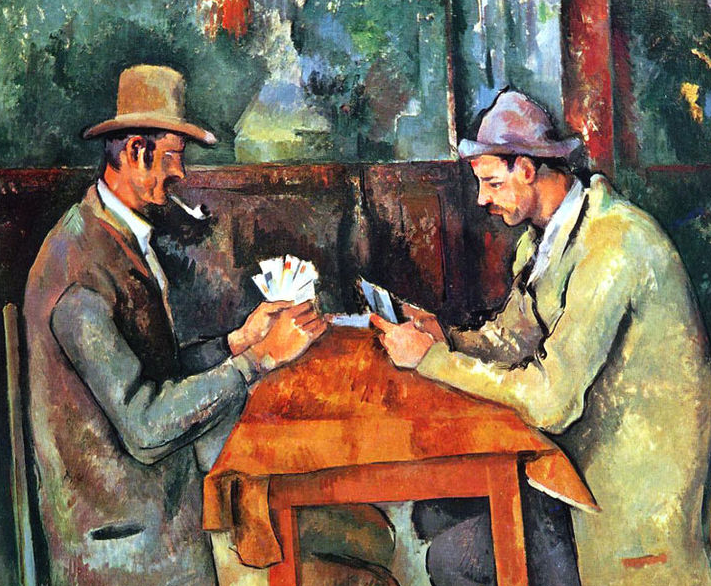
Paul Cézanne's "The Cardplayers"

Paul Cézanne's "The Cardplayers"

If you haven’t been able to tell before now, I’m something of an art enthusiast. I’ve never taken a formal art class — either history or practice — but I’ve been to several of the major galleries of Europe and developed a taste for viewing pieces. Italian Renaissance art and French Impressionism are my two favorite categories.

The Courtauld Gallery is comparatively small, but I was impressed with its pieces. The Gothic religious art, namely several triptychs and polyptychs, and its collection of Peter Paul Rubens paintings are excellent. The Impressionist collection, particularly a few Renoir works, was also awesome to see. A Botticelli painting depicting Christ being lowered from the crucifix featured a portrayal of Mary Magdalene I don’t think I’ve ever seen in a painting, with her hair loose around her in typical Botticelli waves.

The real experience at the gallery, though, was the fabulous short-term exhibit on Paul Cézanne’s “The Cardplayers.” Cézanne is one of those painters whose style is so defined, you can immediately identify his work. I’m a fan of his still-lifes in particular. “The Cardplayers” is a series of paintings depicting French rural peasants playing cards (obviously). The exhibit showed Cézanne’s process, including pencil “cartoons” (early sketches) of the figures and other portraits he had done of the subjects. At the time, his treatment of the peasant class was somewhat cutting-edge, especially given that he often depicted them in more genteel settings, such as his studio or a country house.

After I finished there, I walked (it was nice!) to the Tate Modern. I’m not normally enthusiastic about post-Impressionist work, but I had yet to see Salvadore Dali’s “Metamorphosis of Narcissus” and the Andy Warhol exhibit. After a quick espresso in the cafe, I headed upstairs to view the Dali painting.

The painting has one of the most clever visual tricks I’ve seen. On the one hand, you can see the kneeled figure of Narcissus, who in Greek mythology fell in love with his own reflection in a pool and drowned. The gods turned him into the narcissus flower. On the other side, you see a hand gripping a cracked egg, from which emerges a narcissus flower. Though the two figures are different, they are, in terms of shape, mirrors of each other.

Salvadore Dali's "Metamorphosis of Narcissus"

Salvadore Dali's "Metamorphosis of Narcissus"

I next visited the Warhol exhibit, a room plastered with gauche cow-print wallpaper that Warhol concocted after a friend told him that “no one does pastoral work anymore.” A self-portrait is there, as well as a camouflage installation, a stark black and yellow painting of a dollar sign, and a visceral (tinted with red, like blood) painting of two guns, done after the artist was shot by an admirer.

I spent the rest of the day roaming the city, going across the Millennium Bridge, having lunch at Chipotle (where else), getting a gingerbread cupcake at the Hummingbird (of which I’m now the mayor on Foursquare), walking through St. James’s Park and through Westminster and Whitehall (luckily the student protests have died down), browsing books at Waterstones and going down to the Imperial War Museum to view its Holocaust and crimes against humanity exhibits, in preparation for my human rights class next term.

Another great day in the city.

Paris: Day Four

Read about the first, second and third days in Paris.

Monday, our long weekend in Paris came to a close.

Lauren and I rode the Metro to Gare du Nord and stashed our bags in a locker, so they’d be safe and we wouldn’t have to carry them . We had breakfast — crepes, coffee and apple juice — at a cafe by the train station.

We spent the rest of the morning and early afternoon up in Monmarte, visiting the beautiful Sacre Coeur basilica, which is on a hill and can be seen from across the city, and walking around the district. We stopped outside the Moulin Rouge for photos.

We had heard about good flea and farmers markets in Marais, but unfortunately the ones in which we were interested were closed.

Our next stop was the area around the national opera. After taking photos of the building’s exterior (the interior of lovely also), we visited the Apple store for the free WiFi and got coffee at a very opulent Starbucks. We’re talking chandeliers, tiles ceilings, shiny metal fixtures. It was swank. I also dragged Lauren into the United Colors of Benetton and picked up my souvenir of the trip — a UCoB shirt with “Paris” on it. I have one from London, too. It may just be my new collection.

With the afternoon left to kill, we went back to the Eiffel Tower so Lauren could see it in the daylight. It was so cloudy out that going to the top would have been pointless, as the view would have been obscured, so we hung around down at the bottom, took photos and watched souvenir peddlers run away from the police. Good times.

This slideshow requires JavaScript.

We walked across the Seine to the Trocadero, a complex of gardens and museums. The complex has an impressive history in international affairs — the Universal Declaration of Human Rights was signed there in 1948, and it also housed the first headquarters of NATO.

Lauren and I had one last late lunch together in a restaurant off the Trocadero, before heading back to Gare du Nord. I set up shop in a cafe with a coffee and a croissant, waiting for my train depart. Lauren took an overground commuter train to Orly, from where she was flying back to Germany.

So there you have it. Four eventful days in Paris. Très bon, oui?