A two-month anniversary update

Tomorrow, Oct. 6, will be my two-month anniversary at my job. It’s been very rewarding (and busy, as you can tell from my lack of updates). We’ve added three new sections: defense, financial services and tax. Every day I’m editing stories about budget issues, the health-care reform law, infrastructure, cybersecurity, oil and natural gas production, lobbying and all kinds of other topics. I’m learning a LOT.

I’m also enjoying living in D.C., venturing into new neighborhoods and trying new restaurants and meeting some new people (or rediscovering old ones).

I will not be quite as active on here as I was before I started working, but things are going well and I’m pleased so far with my new capital life.

Paresh Jha debacle is a teachable moment for editors

There are probably three hard-and-fast rules when reporting the news: Keep your personal opinion out of it, don’t steal another person’s work and don’t make things up.

Paresh Jha, a reporter for the New Canaan News, in Connecticut, apparently didn’t adhere to that third rule and paid for it with his job. Craig Silverman, who writes the “Regret the Error” blog for Poynter, has done a great job with following the story as it develops. As of today, Silverman says at least 25 stories of Jha’s have been scrubbed from the paper’s website and there may be more to come.

Many of Jha’s stories feature people with odd names who are unlisted on Facebook and the white pages, teenagers who are just a little too eloquent and sources who are just a little too convenient for the nature of the story. Eventually, when Jha’s stories were put under the microscope — as they should have been before they even ran — they failed to pass muster. Cue sacking.

Much of the focus is on the reporting craft, with this episode used as a morality tale to scare cub reporters away from cutting corners. But I’d say that it actually offers more of a lesson to editors and fact-checkers. Namely, check everything. Ask questions. Verify sources’ identities. Based on the falsehoods that have been pointed out, most of these stories would have been undone by a 5-second Facebook, Google or phonebook check. Benefit of the doubt goes only so far. If something looks too pithy to be true — a driving instructor with the surname Retrede, really? — look into it. Hell, look into it anyway.

This incident isn’t just a reporting breakdown; it’s a failure of the entire editorial process. It shows why papers and news outlets should invest in quality fact-checkers and copy desks (there’s some rumbling that the staff was simply too undermanned), and it exposes the weakness in just taking someone’s word for it.

I’m moving up and moving to Washington, D.C.

It’s been a rough few weeks. I’ve had some personal setbacks and found out that my work permit program in the UK had been closed. But I am thrilled to announce that, as of August 6, I will be a copy editor for POLITICO Pro in Washington, D.C.

If you follow politics at all, you’re probably familiar with POLITICO. The political news site, which also produces a print edition during the week when Congress is in session, launched in early 2007 and quickly became a major media presence in the Beltway. In February 2011, POLITICO launched its Pro platform, a paid subscription service catering to policy professionals — lobbyists, congressional workers, agency officials and whatnot. What began as a three-vertical system (health care, technology and energy) branched into four (transportation launched in April) and will soon be six (defense and finance were just announced).

The “side project” has grown extremely fast and is doing very well; Pro is adding a large number of new journalists, including yours truly. It’s growing and adding staff and subscribers when many outfits are shrinking.

I’ll be joining a relatively young production staff of production editors, copy editors and Web producers. We’re encouraged to try our own side projects. Having met just about everyone in the office last week, I have to say that I am extremely excited to start work.

And of course it will be amazing to move to the capital during an election year. I know so many people there already (including a few who were kind enough to put me up and have meals with me during the interview process), and the city is just a truly awesome place to be.

I’m going back for a few days in July to find a place to live, and probably moving out for good in early August, before I start work. It seems crazy that it’s happening, but I’m glad that my patience and hard work has paid off. I’m ready to go!

Gawker, what did you DO?

I love Gawker. I’ve read it for a few years, since my finals years at KU. It has a wonderful combination of snark and basic content curation. Two things made it stand out: its writers and its comment section. The latter, though, has been dropped on its head.

Gawker’s old-old comment section involved first-time posters replying to posts and/or adding comments to “try out.” Veteran commenters could approve those comments, giving new posters their feet through the door. Such veteran commenters would earn stars, and those stars gave them certain privileges, namely approving new commenters and promoting quality comments. As a poster, you could follow your favorite commenters and be followed in turn.

A few months ago, the old-old system was canned and replaced with a free-for-all. Commenters lost their stars and approval privileges. Spam could be dismissed in the comments section, and “featured” discussions with several replies were pulled out of the larger pile. A definite change of pace from the older system, but not bad.

Cue last week’s announcement by tech writer Adrian Chen, explaining the new commenting system, which involves a crazy, not-intuitive-at-all, carpal tunnel-inducing labyrinth. Instead of getting a clear view of all original threads in one vertical swoop, such threads are now available on a single-click basis, with their replies underneath them. Describing it only makes it sound more confusing, which is the point — it’s nearly incomprehensible and it’s only been in the past day or two that I finally figured it out. The response has been near-universally negative, with many veterans swearing that they’re leaving.

The question now is, what’s next? Is Gawker going to blink and go back to one of the older, more likeable commenting systems? Will it simply ride out the criticism until people get used to it? Will it admit that the change was an error? I really don’t know. I can’t see this new system working; major-traffic threads can easily accrue hundreds of comments, each one necessitating its own click. It’s a chore, it takes the fun out of posting, it’s hard to follow and it takes a four-step article to explain it.

Gawker has a talented stable of writers — I like reading Chen, Hamilton Nolan and Caity Weaver, and was sad to see Richard Lawson, Maureen O’Connor and Brian Moylan go — but its comments have always been a huge, huge draw for the site. I will definitely be paying attention in the next few months to see how the commenting system changes, if it does. It may prove to be a valuable lesson in terms of Web design, development and user relations.

A breakthrough in the News International fiasco

Earlier today, Rebekah Brooks, the ex-chief executive of Rupert Murdoch’s News International, finally had to pay the piper. Namely, Brooks, her husband and four others were charged with “perverting the course of justice” by concealing evidence from the police who were investigating NI’s phone-hacking allegations.

I was in England for much of the early investigation. I saw both Rupert and James Murdoch questioned before a committee, and I saw Rupert’s wife Wendy smack the guy who tried to pie him. Good times.

Today’s news, though, seems like sound evidence that what many people had feared — nobodies would fall on the sword and Brooks and others like her would get away clean — won’t come to pass. There’s still a lot to go; these are only charges, of course. But I think it’s a step in the right direction.

This entire debacle has been a stain on British journalism, much of which is controlled by Murdoch. The allegations tossed around — hacking a murder victim’s phone, among other things — are atrocious, and seem to point to a systemic culture of “the ends justify the means” behavior.

But now, with Brooks and others finally on the chopping block, there might finally be some closure, or at least a sense of justice being done. Stay tuned.

Do facts have a bias?

It’s primary season. As a student of politics, I love it. It’s exciting and interesting and oh so messy. But there is one thing about it that frustrates me endlessly: the media’s lack of punch.

Journalists are supposed to be objective and keep their biases out of their work as much as possible. Lately, though, this has been taken to such an extreme that the media — the fourth estate and supposedly responsible for holding the powerful accountable — have turned toothless, for fear that someone will accuse them of bias or carrying out hit jobs. One of the biggest lessons that still resonates with me from J School came from my adviser. The gist is, “There’s a difference between being fair and being equal.”

There might be a segment on a news program called, “The Earth: Round or Flat?” In a fair model, a person who believes the earth is flat would never be given a platform or would be soundly shut down, because it’s a fact that the earth is not flat. In an equal model, one person who believes that the earth is round would debate a person who believes that the earth is flat. They’d yell at each other for 45 seconds, the anchor would sit impotently by and then sign off without settling the matter, leaving it open-ended and allowing the audience to believe that maybe there really is something to this flat-earth business.

In a recent debate, Mitt Romney made an error and mentioned something about John Adams authoring the Constitution. The moderator didn’t address this, nor did anyone else after the fact that I saw. The Constitution was largely authored by James Madison. I give Romney the benefit of the doubt and assume he made a harmless error, but that the moderator or another candidate didn’t correct it right then — either out of apathy, ignorance or fear of reprisal — is troubling.

That’s an example about a historical event in American history. What if the issue pertains to job growth, defense spending, abortion or health-care reform? A serious flaw in the debates is that the moderators always seem to ask questions with a hypothetical tilt. “What would you do about this?” I’d much rather see a fact-based question that forces the candidates to defend a position they’ve already taken. “You’ve said that X has been decreasing, but this data from Non-Partisan Research Body shows that X has actually been increasing. Do you care to explain your position, or provide a source for your data?”

Even better, have a squad of fact-checkers working during the debate and challenge assertions that candidates make during the debate. These days, fact-checking occurs after the debate is over, if it happens at all. Assuming that people even tune into the debates, I doubt that many of them stick around to see CNN or Fox or MSNBC or ABC go over and fact-check something that was said two or three hours ago or even two or three days ago. If there’s a question of veracity, bring it up then and have the candidates defend it then. 

Much of the disinformation peddled during elections — not just primaries, but general elections too — is aided and abetted by journalists’ unwillingness to take the gloves off and do their jobs. Will they make enemies this way? Sure. But it seems like too many political journalists these days are more interested in schmoozing and gossip and buddying up with candidates than they are in actually examining and evaluating their campaign platforms. As my dad said when I embarked on my (high school, haha) journalism career: “If you’re not pissing anybody off, you’re not doing your job.”

The day the Web went dark

Visit Google lately? Or Wikipedia? Or WordPress?

On Wednesday, each of these sites (and others, including BoingBoingTwitpic and Reddit) will “go dark” in protest of the Stop Online Piracy Act (SOPA) and the Protect IP Act (PIPA). Both of these bills have seemingly innocuous names (piracy is bad), but a measured dissection shows how damaging they would be to the Web and to free expression.

Chris Heald wrote an excellent criticism of SOPA on Mashable, providing clear positions and using layman’s terms to explain just what about SOPA is so troubling. Heald makes his opinion clear: “If a programmer on my team wrote code as convoluted as this bill, I would fire him on the spot.”

Here are some of the bill’s provisions:

1. The attorney general could take action against any site found to “facilitate” copyright infringement. As Heald points out, the site need not be solely for content theft. Text and photos on otherwise law-abiding sites could be targeted, as could links. This would include sites like Facebook, Gmail, Google, YouTube, Tumblr and God only knows how many others. Want to upload a video of yourself singing, say, “Rolling in the Deep”? Heald points out that, at $1 a pop (what the song sells for as a legal download), if your video gets 2,500 views, you’ll have committed a felony. This is without any monetary gain on your part, by the way. (Obligatory joke about, “Most YouTube performances are terrible, but this is ridiculous!”)

2. Search engines would have to scrub the offending sites from their listings, and advertising services would have to cut ties.

3. Your ISP would have to censor your access to foreign sites that the U.S. government could not take down on its own. One such site? Wikileaks.

The overall gist? This bill would effectively cripple Web development by putting it under de facto government control, gut online advertising potential, give the government (or more precisely, the corporations buying off the government) a frightening amount of censorship authority and criminalize virtually … everything, nearly anything you or I do in day-to-day Web use, no matter how innocent. The big push for the legislation comes from the RIAA and the MPAA in an effort to curb music and film piracy, respectively. What it actually does is aim a bazooka at an anthill, targeting content pirates and innocent-but-unlucky Web users alike.

Being a journalist, I’m extremely wary of anyone who would try to deny me or anyone else access to information. It demonstrates a troubling willingness to assert unilateral control over citizens’ Web-usage habits and I believe that it discourages Web innovation, because the fear of reprisal would prevent start-ups from attempting to get off the ground. Look at how many great American tech companies would be affected by this legislation. It’s enough to scare off anyone else.

Thankfully, it looks like SOPA may not be long for this world. However, I think it’s important for people to still understand what it is and how critical it is that it or something like it never be allowed to pass. This is the information age, and information is power. Don’t give it up so easily.

The full text of the bill can be found here

Adventures in personal branding: a new website

Using Dreamweaver is like riding a bike: You never really forget how to work it. Unless you drive yourself crazy trying to figure out how to move a div with a Flash presentation in it.

I had plenty of Dreamweaver experiences in J School, but it wasn’t until I had Adobe CS5 for my very own (OK, I got it back in December) and some free time that I decided to finally sit down and make my own personal site. I believe a unique website is something any serious journalist should have, no matter what they do: reporting, editing, photography or design.

I’ve had the WordPress set-up for almost two years. It was meant to be a stop-gap solution until I had long-term access to Adobe again. Essays and schoolwork kept me from doing anything this past spring, but now I have some flexibility. My goal is to transfer my photos, clips and CV to the new site and maintain my WordPress page as a stripped-down, blog-only site.

If you’ve never sat down and built your own website from scratch, I recommend it. It builds character, especially if you’re like me — knowledgeable about the basics of coding but not into anything fancy. It’s kind of fun, picking out colors and typefaces and seeing it come together when you test it in your browser.

One major point that I’m trying to keep in mind is SEO. Namely, I’m making sure that important points are done in searchable text, not just graphics. My navigation so far is graphic-heavy (namely, funky buttons), but I plan to make my CV and portfolio pages as textual as possible. If you’re thinking about making your own site, make sure that your content will show up in search engines.

The work has also given me the chance to reacquaint myself with an old nemesis: Flash. I don’t particularly care for it, but I needed its sweet, sweet slideshow utility. Three hours later I had what I wanted. It looks pretty good. I still don’t like Flash.

So my work continues, and I’m hopeful that within a few weeks I’ll have something that I’m comfortable taking live.

Just please don’t look at the code. I tend to overcompensate with code detail and I prefer my CSS to be listed with everything else, even though it’d be far more logical to just attach a separate stylesheet. I like being able to see everything.

So please, if and when my page goes up, ignore my granny pants.


Adventures in personal branding: the business card

There’s a scene in “American Psycho” where psycho-in-question Patrick Bateman (Christian Bale) and his colleagues compare business cards. To the viewer, the cards look identical. It’s only through the group’s discussion and Bateman’s inner dialogue that we learn the differences: colors on the white spectrum, typeface, paper weight, watermark.

So … psycho … is Bateman over the perceived inferiority of his own business card that he commits murder as a direct result. (Or does he? I’ll leave the story’s numerous interpretations alone.)

How would Patrick Bateman respond to Vistaprint?

I found Vistaprint last year through 10,000 Words, one of my favorite journalism blogs. The entry suggested that journalists were moving away from identifying with an established company (say, their newspapers or stations), and further toward identifying as one-man (or -woman) operations.

Faced with no longer having a newspaper with which to identity, I’ve spent much of the last year and a half cultivating my own personal brand. I tweet all the time, I blog and I follow a variety of people and news organizations. I redesigned my CV and made sure to join emerging social networks.

And I made a business card.

While it’s been a few months since I did this, I thought now — in the midst of post-graduation job-hunting — might be a good time to describe my process.

1. I browsed Cardonizer, looking for inspiration. The examples on Cardonizer vary from the chic to the absurd, but all are eye-catching.

2. I decided what information I wanted to include. I settled on my email, phone numbers, website and Twitter handle. I also decided to list my basic job titles/attributes, from the more serious (copy editor) to the more personal (traveler).

3. I “sketched” a rough layout in InDesign. One card I’d seen had used icons, so I decided to make my own. I painstakingly drew a cursor (website icon), an envelope (email icon) and two mobile phones (phone icons), and found a black Twitter icon. I placed all of my icons in the middle of squares with rounded edges, to make them look like buttons.
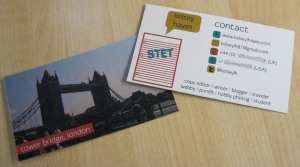
My business card.

My business card.

4. I selected a color palette. In addition to black for the text, I used the same cranberry-blueberry-lime combination that I’d chosen for my magazine prototype.

5. I added the text and chose a typeface. The contact information is prominently featured on the right, while my professional/personal attributes are lined up along the bottom, separated by colored vertical lines. I selected Merge for my typeface, a clean, slender sans serif that looks modern without being too cold.

6. I created my own “logo.” In my case, I drew a piece of notebook paper in one color (cranberry) and splashed a big “STET” across it in another color (blueberry). My name appears within a lime-colored dialog box, in black text.

7. Because Vistaprint lets you use both sides of the card, I selected a photo of mine for the back (Tower Bridge). I captioned the photo with a simple cranberry-colored bar, with white text.

8. I saved and exported both sides of the card and went through the motions on Vistaprint. I selected my order volume, chose a paper color and weight and cropped the graphics to fit the appropriate frame. Once I was satisfied, I ordered my cards. Voila.

The hardest part for me was settling on a design. It may be easier to use a template, but there’s something rewarding about making your own card from scratch. I know that mine’s unique, and love that it’s zippy and colorful while still being informative.

So if you’re thinking about making your own business card, knock yourself out. Chalk it up to bolstering that personal brand.

What’s Google+ waiting on?

Google+ is working on developing business/brand accounts, and asking businesses not to join the network yet. It seems reasonable on the surface, but it could easily backfire.

A couple of weeks ago, I wrote about my first impressions of Google+. I liked it a lot then, and I like it now. I’m noticing, though, that there’s an unhappy trend in posts from people in my Circles. There’s a prevailing attitude of, “Well now what do we do?”

Some brands have managed to slip through. Pete Cashmore of Mashable has a personal Google+ profile that he’s now “winding down” in preparation for a Google+ branded account for Mashable. This is after Mashable’s original personal-esque account went on hiatus. It’s enough to give you whiplash.

Given the benefit of hindsight, I have to wonder if Google wouldn’t have been wiser to beta test branded accounts first, or in conjunction with the very first personal accounts. Waiting until the site has 20 million users before actively discussing branded accounts (and suspending many branded accounts masquerading as personal ones) is like opening a shopping mall with no stores.

A site like Facebook, which started out as personal and casual and only gradually migrated to a more business-friendly approach, is a different animal. The main draw of Google+, near as I can tell, was always the networking/professional aspect. Some people I follow or who follow me use it casually, but the vast majority of them post about technology, journalism and politics. Even the personal is professional.

We can always discuss such things on personal accounts, but if we can’t engage with “official” newspaper, TV station, magazine, business and news site accounts, what can that accomplish?

Google+ needs to present a clear and compelling reason for its existence and open up the personal-to-business channels, or it’ll be drowning in cat GIFs in six months for lack of anything else for people to do.