A long-overdue update

Hello everyone!

I’ve been busy writing my dissertation and packing and moving, but I thought I’d drop in a little note.

Exactly one year ago, I left for England. Today I received my graduation invitation from Kent: November 18 in Canterbury Cathedral. I’m hoping that next week I can get my bank statement and graduation letter from the school, and submit my work permit application.

For the time being I’m staying up in Seasalter, a little village on the North Sea, with some friends who’ve generously allowed me to stay with them while I sort my paperwork out and start applying for jobs. I’ll update more as stuff happens, but that’s where I am now. Life is good!

A comment on David Cameron’s social media remarks

Earlier today, British Prime Minister David Cameron and Labour Party leader Ed Miliband both spoke in the House of Commons about the English riots. While browsing a timeline of the remarks, I was struck by something Cameron said: The government and the police were reviewing the “role of social media” in organizing the riots. At about 1 p.m., the Telegraph reported that Cameron went on to clarify, saying that sites like Twitter “could be closed down during periods of disorder.”

That general line of thinking set off my squick alarm. In the U.S., at least, speech that deliberately incites rioting or lawbreaking isn’t protected. On that note, I’m not sure it’s a good idea to A) single out social media and B) set a precedent of police and government interference in social media platforms. One night Twitter may be shut down to prevent rioting, but what else could a shut-down prevent? Who gets to decide what constitutes a “period of disorder”?

The Register took a similar tack, and wondered why Cameron wasn’t also chastising news stations for round-the-clock helicopter coverage. Such coverage, The Register suggested, gave as much of an idea as to which areas were unprotected as Twitter did.

Two years ago during the Tehran protests, Twitter was one of the only ways to get information into or out of Iran. It also played a large role in the recent Arab Spring uprisings. At its core, Twitter can be used by the disenfranchised to spread information and share their experiences. It has, I believe, a legitimate democratic underpinning, which is why I also believe that a short-sighted knee-jerk decision to shut it down in the face of yob rule is well-intentioned but ultimately misguided, if not overly authoritarian.

No one wants to see looting, rioting or property damage, but rather than simply cut off social media, the police would be wiser to adapt and use social media to infiltrate planned outbreaks. Eliminating all information would make law enforcement blind and deaf, too.

I see Cameron’s point, and I understand that much of it is the product of legitimate anger and frustration over the past few days, but if ever there was a “be careful what you (they?) wish for” moment, this is it.

Change your bookmarks for this blog

Hello hello! I have formally switched my domain registration to my new Web host, and as soon as my FTP business is taken care of, my new site should be up and running.

The home page for this blog will be www.kelseylhayes.wordpress.com. If you have the blog bookmarked, change the link to the WordPress URL. Once my site goes up, that will be the new kelseylhayes.com. It’s in 404 error mode at the moment.

Apologies for any hiccups or confusion.

Because I’m really excited about the new site, I decided to go ahead and include a screenshot gallery. Hopefully this won’t jinx anything.

This slideshow requires JavaScript.

New website coming (very?) soon

After five days, a good 50-60 hours and countless cups of coffee and diet Coke, my new website is built.

I’ve validated my HTML, double-checked all of my links and graphics, made sure I had the correct stylesheets attached and test-driven that puppy in five different browsers. I used nearly every program in Adobe CS5: InDesign, Photoshop, Dreamweaver, Flash and Fireworks. I can hardly wait to take it live.

My plan is to transfer my domain (kelseylhayes.com) to the new site, and revert to the old WordPress domain for this blog. I’ll make sure to heavily link between the two (my site actually has a “blog” button), but you may need to bookmark my blog again once the new site goes up. All of my work and photos, plus links to my CV, will be on the new site. Once it goes up, my blog will just be a blog.

I thought about posting screenshots, but I don’t want to jinx it. Here’s hoping the hosting process goes smoothly. Wish me luck.

Adventures in personal branding: a new website

Using Dreamweaver is like riding a bike: You never really forget how to work it. Unless you drive yourself crazy trying to figure out how to move a div with a Flash presentation in it.

I had plenty of Dreamweaver experiences in J School, but it wasn’t until I had Adobe CS5 for my very own (OK, I got it back in December) and some free time that I decided to finally sit down and make my own personal site. I believe a unique website is something any serious journalist should have, no matter what they do: reporting, editing, photography or design.

I’ve had the WordPress set-up for almost two years. It was meant to be a stop-gap solution until I had long-term access to Adobe again. Essays and schoolwork kept me from doing anything this past spring, but now I have some flexibility. My goal is to transfer my photos, clips and CV to the new site and maintain my WordPress page as a stripped-down, blog-only site.

If you’ve never sat down and built your own website from scratch, I recommend it. It builds character, especially if you’re like me — knowledgeable about the basics of coding but not into anything fancy. It’s kind of fun, picking out colors and typefaces and seeing it come together when you test it in your browser.

One major point that I’m trying to keep in mind is SEO. Namely, I’m making sure that important points are done in searchable text, not just graphics. My navigation so far is graphic-heavy (namely, funky buttons), but I plan to make my CV and portfolio pages as textual as possible. If you’re thinking about making your own site, make sure that your content will show up in search engines.

The work has also given me the chance to reacquaint myself with an old nemesis: Flash. I don’t particularly care for it, but I needed its sweet, sweet slideshow utility. Three hours later I had what I wanted. It looks pretty good. I still don’t like Flash.

So my work continues, and I’m hopeful that within a few weeks I’ll have something that I’m comfortable taking live.

Just please don’t look at the code. I tend to overcompensate with code detail and I prefer my CSS to be listed with everything else, even though it’d be far more logical to just attach a separate stylesheet. I like being able to see everything.

So please, if and when my page goes up, ignore my granny pants.


Adventures in personal branding: the business card

There’s a scene in “American Psycho” where psycho-in-question Patrick Bateman (Christian Bale) and his colleagues compare business cards. To the viewer, the cards look identical. It’s only through the group’s discussion and Bateman’s inner dialogue that we learn the differences: colors on the white spectrum, typeface, paper weight, watermark.

So … psycho … is Bateman over the perceived inferiority of his own business card that he commits murder as a direct result. (Or does he? I’ll leave the story’s numerous interpretations alone.)

How would Patrick Bateman respond to Vistaprint?

I found Vistaprint last year through 10,000 Words, one of my favorite journalism blogs. The entry suggested that journalists were moving away from identifying with an established company (say, their newspapers or stations), and further toward identifying as one-man (or -woman) operations.

Faced with no longer having a newspaper with which to identity, I’ve spent much of the last year and a half cultivating my own personal brand. I tweet all the time, I blog and I follow a variety of people and news organizations. I redesigned my CV and made sure to join emerging social networks.

And I made a business card.

While it’s been a few months since I did this, I thought now — in the midst of post-graduation job-hunting — might be a good time to describe my process.

1. I browsed Cardonizer, looking for inspiration. The examples on Cardonizer vary from the chic to the absurd, but all are eye-catching.

2. I decided what information I wanted to include. I settled on my email, phone numbers, website and Twitter handle. I also decided to list my basic job titles/attributes, from the more serious (copy editor) to the more personal (traveler).

3. I “sketched” a rough layout in InDesign. One card I’d seen had used icons, so I decided to make my own. I painstakingly drew a cursor (website icon), an envelope (email icon) and two mobile phones (phone icons), and found a black Twitter icon. I placed all of my icons in the middle of squares with rounded edges, to make them look like buttons.
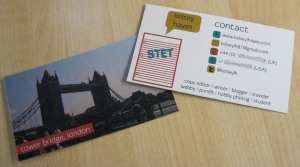
My business card.

My business card.

4. I selected a color palette. In addition to black for the text, I used the same cranberry-blueberry-lime combination that I’d chosen for my magazine prototype.

5. I added the text and chose a typeface. The contact information is prominently featured on the right, while my professional/personal attributes are lined up along the bottom, separated by colored vertical lines. I selected Merge for my typeface, a clean, slender sans serif that looks modern without being too cold.

6. I created my own “logo.” In my case, I drew a piece of notebook paper in one color (cranberry) and splashed a big “STET” across it in another color (blueberry). My name appears within a lime-colored dialog box, in black text.

7. Because Vistaprint lets you use both sides of the card, I selected a photo of mine for the back (Tower Bridge). I captioned the photo with a simple cranberry-colored bar, with white text.

8. I saved and exported both sides of the card and went through the motions on Vistaprint. I selected my order volume, chose a paper color and weight and cropped the graphics to fit the appropriate frame. Once I was satisfied, I ordered my cards. Voila.

The hardest part for me was settling on a design. It may be easier to use a template, but there’s something rewarding about making your own card from scratch. I know that mine’s unique, and love that it’s zippy and colorful while still being informative.

So if you’re thinking about making your own business card, knock yourself out. Chalk it up to bolstering that personal brand.

Accio Pottermore

Sunday morning, I watched the TweetDeck column, cordoned off by hashtag, explode with updates. “OMG I got in!!” “Where’s my email?!” “Registration is now closed, nooo!” I saw tweets in English, Spanish, French, German and Italian, and probably a few other languages I couldn’t have identified.

It was all for Pottermore.

The site is spending exactly one week — seven days for seven books — giving one million fans the opportunity to answer trivia for a chance to access the site early. Early adopters get to join a beta version of the site sometime in August and September; everyone else has to wait until October. By my calculation, about 142,000 registrations are allowed in any given day (a million spread out over seven days), and when that quota’s been filled, registration closes.

Despite going live when most of the U.S. should have been sleeping (about 9 a.m. in the UK, 4 a.m. on the East Coast), Pottermore registration lasted a little more than an hour before it closed. Fans who missed out have six more chances to get in.

What the project ultimately is remains to be seen. The site itself describes it as an “exciting new experience from J.K. Rowling based around the Harry Potter books.” (Editor’s quibble: Can something be based around something else?)

If you follow the publicity campaign, you’ll read that Pottermore will allow fans to have an interactive Potter experience. They can get wands, be sorted into houses and follow along with the books’ progression. The nitty gritty is still, of course, a mystery.

It got me thinking, though — if Pottermore is a success, might its model be adapted for other purposes? The main draw appears to be immersion in the story with other fans. But this is a fictional story — what if the subject matter was a long-term investigative reporting piece? Could this model represent an evolution from passive reading/viewing to active audience participation? Pottermore will definitely have a social media aspect. Could that be used in other models to mine data for reporting ventures? Could a Pottermore-like infrastructure turn into the next great crowd-sourced project?

I think journalists and social media managers would be wise to observe Pottermore’s evolution and apply what they learn to their own work. It’s untilled ground thus far, which makes it much more exciting.

It’ll be a few weeks before I can use Pottermore for myself and report back on what I find. Fortunately I managed to solve the clue and register for early access in time. One of my nerdier moments, if I may say so.

I’ll keep my username to myself for the moment, but here’s a clue: It works for both Harry Potter, and A Song of Ice and Fire. Double geekiness.

What’s Google+ waiting on?

Google+ is working on developing business/brand accounts, and asking businesses not to join the network yet. It seems reasonable on the surface, but it could easily backfire.

A couple of weeks ago, I wrote about my first impressions of Google+. I liked it a lot then, and I like it now. I’m noticing, though, that there’s an unhappy trend in posts from people in my Circles. There’s a prevailing attitude of, “Well now what do we do?”

Some brands have managed to slip through. Pete Cashmore of Mashable has a personal Google+ profile that he’s now “winding down” in preparation for a Google+ branded account for Mashable. This is after Mashable’s original personal-esque account went on hiatus. It’s enough to give you whiplash.

Given the benefit of hindsight, I have to wonder if Google wouldn’t have been wiser to beta test branded accounts first, or in conjunction with the very first personal accounts. Waiting until the site has 20 million users before actively discussing branded accounts (and suspending many branded accounts masquerading as personal ones) is like opening a shopping mall with no stores.

A site like Facebook, which started out as personal and casual and only gradually migrated to a more business-friendly approach, is a different animal. The main draw of Google+, near as I can tell, was always the networking/professional aspect. Some people I follow or who follow me use it casually, but the vast majority of them post about technology, journalism and politics. Even the personal is professional.

We can always discuss such things on personal accounts, but if we can’t engage with “official” newspaper, TV station, magazine, business and news site accounts, what can that accomplish?

Google+ needs to present a clear and compelling reason for its existence and open up the personal-to-business channels, or it’ll be drowning in cat GIFs in six months for lack of anything else for people to do.

Your Social Media Strategy Here

Fertilizer-pushing is not my strong suit.

I’m deep, deep into the job hunt at the moment. When I apply for a position, I do my very best to use direct, plain language. If I describe an achievement or a milestone, I use tangible markers. Kansan.com saw increased site traffic and expanded multimedia content, and won a Pacemaker from the Associated Collegiate Press when I was the site’s managing editor. See how simple that was?

No mention of “humanizing the brand.” Or starting “organic conversations.” Or “leveraging influencers.”

Almost a year ago, I wrote about social media strategy with the same level of annoyance, and nothing has really changed.

How can we, as journalists, put such a high value on clear, concise language, while simultaneously clogging our CVs, “About” sections and job postings with rhetorical nonsense? If I read a job posting and can’t even figure out what my daily duties would be, I move on.

In my earlier post, I hypothesized that maybe we use vague language to describe social media because even we haven’t really figured it out yet. Or we want to seem indispensable. I grimace when I see anyone describe themselves as a “social media guru.” There is nothing spiritual about Twitter, I promise. If you’re that good, you don’t need to hide behind flowery language.

Ascribing some higher level of importance or even mysticism to social media ignores or downplays the stone-cold truth: If you link to quality content and reply to your audience respectfully and helpfully, you will gain and maintain followers. If you ignore queries or rarely tweet or spam people, you won’t. From the perspective of a company like Foursquare, successful branded accounts will post tips early and often and reward their followers with badges and possible merchandise discounts. Foursquare is, at its root, a game. So give your customers that experience.

I love editing. I love the ins and outs of journalism on the Web, and I love social media and what it can accomplish in terms of connecting people and spreading information. I love those things so much that I can call a spade a spade. I can say exactly what I do. I hope others can do the same.